
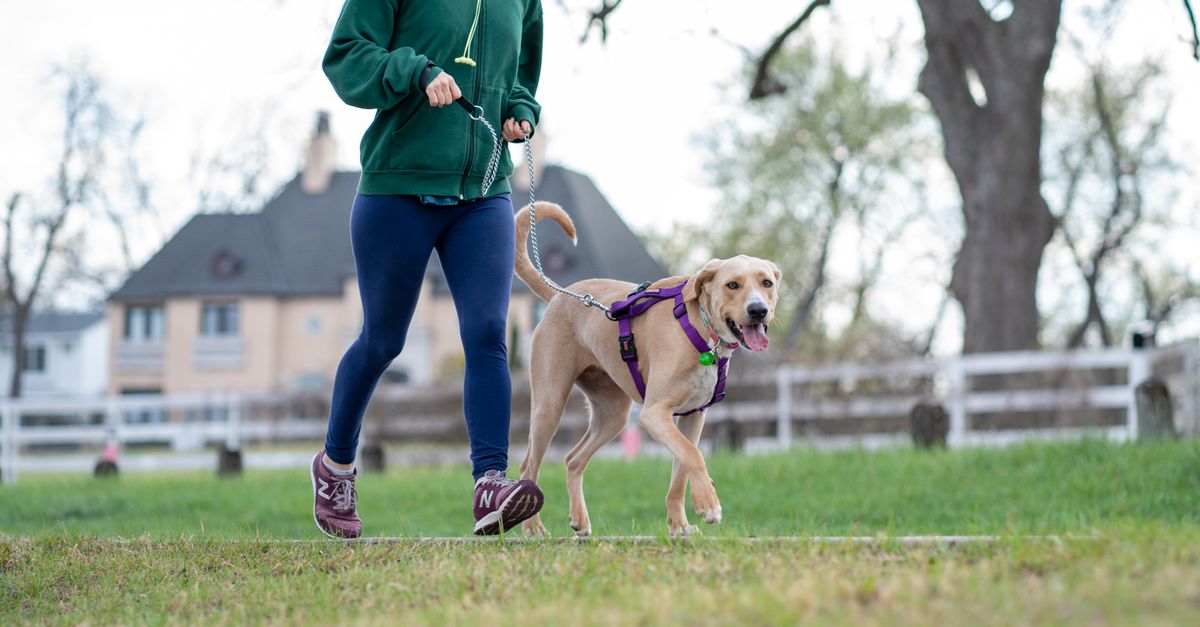
You've mastered the basics: your dog understands that tension on the leash stops forward movement and that position near you earns rewards. But real-world walking is harder — other dogs, squirrels, interesting smells, and miles of pavement test patience and training. This guide addresses the gap between "gets the concept in the backyard" and "walks beautifully through a busy farmer's market."
- The Engagement Foundation
- Proofing Through Distraction Levels
- Duration Building
- Troubleshooting Plateaus
- Problem: Dog walks well for a few minutes then deteriorates
- Problem: Good at home, terrible on new routes
- Problem: Triggers cause complete breakdown (squirrel, dog)
- Problem: Other family members undo training
- Real-World Application Tips
- Frequently Asked Questions
- Is it realistic to expect my dog to walk in perfect heel position for an entire walk?
The Engagement Foundation
The dog must find YOU more interesting than the environment. This is trained, not expected:
- Name game: Say dog's name → instant eye contact → mark + treat. Practice hundreds of times in increasing distraction.
- Voluntary check-ins: Anytime on a walk that the dog glances at you WITHOUT being asked → mark + treat. Build a habit of checking in.
- Pattern games: Predictable movement patterns (123 treat, 123 treat) build rhythm and engagement during walks.
- Surprise jackpots: Random moments of extraordinary reward during walks (a handful of treats + excited praise). Keeps the dog hopeful and attentive.
Proofing Through Distraction Levels
| Level | Environment | Criteria |
|---|---|---|
| 1 | Indoors, no distractions | Loose leash for 30+ steps continuously |
| 2 | Backyard/quiet driveway | Loose leash with mild environmental interest |
| 3 | Quiet neighborhood street | Loose leash with occasional dogs/people visible at distance |
| 4 | Moderate traffic area | Maintains position passing other dogs/people on sidewalk |
| 5 | High distraction (pet store, farmer's market, busy park) | Loose leash despite intense stimulation |
Duration Building
Most dogs can walk nicely for 30 seconds. The challenge is maintaining it for a 30-minute walk:
- Structured vs. sniff walks: Alternate between "with me" (position, focus, loose leash) and "go sniff" (freedom to explore at leash length). This prevents mental fatigue.
- 5:1 ratio initially: 5 steps of structured walking → release to sniff/explore. Gradually increase structured segments.
- Mark the end of good segments: After 20 good steps → "Free!" + release to sniff. Walking nicely EARNS freedom (Premack).
Troubleshooting Plateaus
Problem: Dog walks well for a few minutes then deteriorates
Solution: End structured walking BEFORE deterioration. Short perfect sessions > long degrading ones. Build duration gradually.
Problem: Good at home, terrible on new routes
Solution: Generalization failure. Practice in 10+ different environments. Skills must be taught in each new context initially.
Problem: Triggers cause complete breakdown (squirrel, dog)
Solution: This is reactivity/prey drive, not a leash-walking issue. Address the emotional response to triggers separately (CC/DS), then integrate with walking protocol.
Problem: Other family members undo training
Solution: Everyone must use the same rules. If one person allows pulling, the dog learns "pulling works with some people." Consistency across all handlers is non-negotiable.
Real-World Application Tips
- Two-leash system: One leash for "with me" training walks, different equipment for "just a potty break" walks. Dog learns different expectations based on equipment.
- Pre-walk exercise: Take the edge off arousal with fetch or tug BEFORE training walks. Attempting loose leash with a dog at 10/10 energy is setting up for failure.
- Front-clip harness for management: Use management tools on non-training walks. It's okay to use tools that make life pleasant while ALSO training during dedicated sessions.
Frequently Asked Questions
Is it realistic to expect my dog to walk in perfect heel position for an entire walk?
No — and it's not necessary. "Loose leash walking" means: the leash has a J-curve (slack) and the dog can be anywhere within leash length. "Heel" means: precise position at your left side. For pet dogs, loose leash is sufficient and more realistic. Save precise heel for competitions or brief moments when you need close control (passing another dog, crossing streets).