
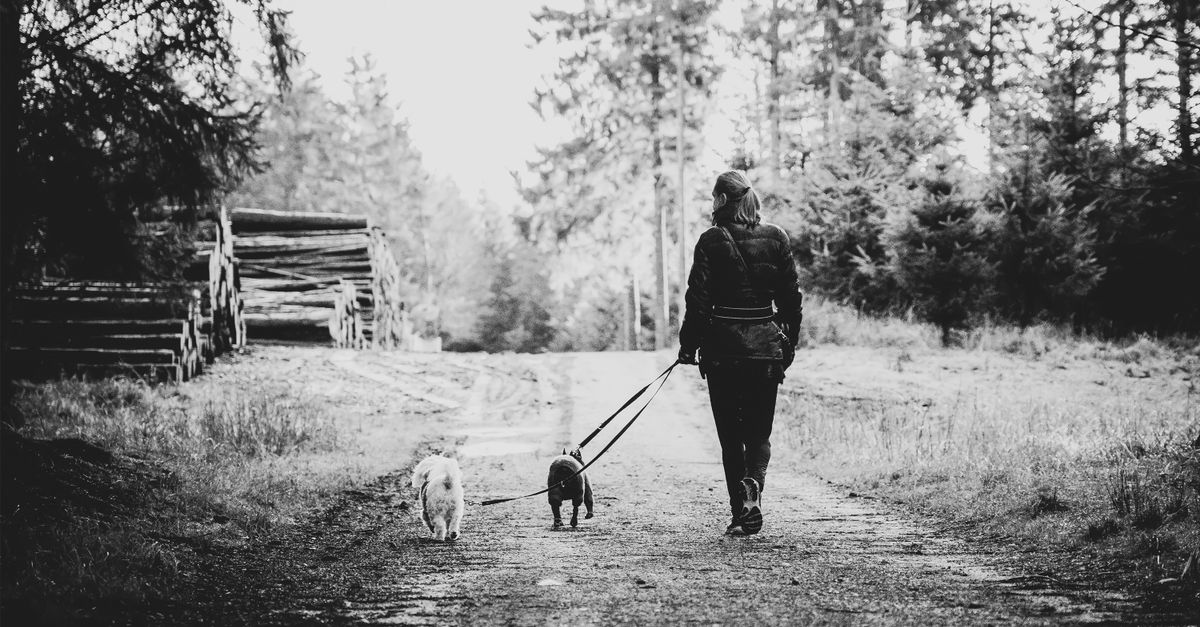
You've trained loose leash walking in quiet environments — but the moment another dog appears, a squirrel runs, or a friendly person approaches, all training dissolves. This isn't a training failure; it's a distraction-proofing gap. Each type of distraction requires a slightly different approach because the underlying motivation differs: social excitement (dogs), predatory arousal (squirrels), or greeting excitement (people).
Passing Other Dogs
Why It's Hard
Other dogs represent either: social excitement ("I want to say hi!"), frustration ("I want to go there but can't!"), or anxiety ("That dog might be threatening!"). All three create arousal that overwhelms leash manners.
Protocol
- Increase distance: Cross the street, u-turn, or create a buffer. More space = less arousal.
- Get attention before threshold: Mark and reward your dog for looking at YOU when the other dog is still far away.
- "Look at that" game: Dog looks at other dog → you mark → dog looks back at you for treat. Build: look at distraction → auto-check-in with handler.
- Keep moving: Don't stop and stare at the other dog. Maintain forward momentum past the distraction.
- High-value rewards: Other dogs = special treats (real chicken, cheese) — not kibble. The reward must compete with the distraction's value.
Squirrels and Wildlife
Why It's Hard
Prey drive is hardwired instinct operating on a different neurological circuit than trained behaviors. Chase is intrinsically reinforcing — no external reward needed. Your treats are competing against 15,000 years of genetic programming.
Protocol
- Pattern interrupt at "orient": The moment your dog spots prey (ears perk, body stiffens) but BEFORE it launches → "Watch me!" or u-turn. You have a 1-2 second window.
- Emergency u-turn: Practiced until automatic. Say "this way!" → turn 180° → treat. Dog follows because the u-turn is so heavily reinforced.
- Premack principle: Dog sees squirrel → holds position/looks at you → reward = permission to WATCH (not chase) the squirrel from leash distance.
- Management: Avoid squirrel-heavy routes during training. Some dogs will never be reliable around prey at close range — manage rather than fight genetics.
Friendly People
Why It's Hard
People represent social reinforcement. If the dog has a history of running up to people and receiving petting/attention, pulling toward people has been heavily rewarded. Plus, people are unpredictable — some encourage the dog, undermining training.
Protocol
- No greetings while pulling: Pulling toward a person = you stop. Dog cannot reach the person. Pressure off leash = you resume walking (toward person if appropriate).
- Sit to greet: Dog must sit before person can approach/pet. Person stops approaching if dog breaks sit.
- Brief your accomplices: Ask people to help: "Only pet if all four paws are on the ground." Most people are happy to comply.
- Not everyone is for greeting: Most people you pass on walks are NOT for interaction. Teach your dog that default is: walk past. Greetings are the exception (cued by you).
General Principles
- Set up for success: Don't walk routes with maximum distraction during training. Choose routes where you can maintain distance and control exposure.
- Reward check-ins: EVERY voluntary look at you during walks (especially near distractions) gets marked and rewarded. Build the habit of looking to you in uncertainty.
- Management is okay: Front-clip harness for management walks, flat collar for training walks. You don't have to "train" every walk — some walks are just for exercise/enjoyment with management tools.
Frequently Asked Questions
Will my dog ever walk calmly past other dogs?
Most dogs can achieve significantly improved leash manners around other dogs with 4-8 weeks of consistent work. "Perfect" calm is unrealistic for many social or frustrated dogs — but "manageable with minimal redirection" is achievable for most. The dog that previously lunged and screamed can become the dog that glances and looks back at you. That's enormous progress.